
The Vietnam War has been the subject of thousands of newspaper and magazine articles, hundreds of books, and scores of movies and television documentaries. The great majority of these efforts have erroneously portrayed many myths about the Vietnam War as being facts. [NIXON]
 Myth: Most American soldiers
were addicted to drugs, guilt-ridden about their role in the war, and
deliberately used cruel and inhumane tactics.
Myth: Most American soldiers
were addicted to drugs, guilt-ridden about their role in the war, and
deliberately used cruel and inhumane tactics.
The facts are:
91% of Vietnam Veterans say they are glad they served [Westmoreland]
74% said they would serve again even knowing the outcome [Westmoreland].
There is no difference in drug usage between Vietnam Veterans
and non veterans of the same age group (from a Veterans
Administration study) [Westmoreland]
Isolated atrocities committed by American soldiers produced
torrents of outrage from antiwar critics and the news media while
Communist atrocities were so common that they received hardly any
attention at all. The United States sought to minimuze and prevent
attacks on civilians while North Vietnam made attacks on civilians a
centerpiece of its strategy. Americans who deliberately killed
civilians received prison sentences while Communists who did so
received commendations. From 1957 to 1973, the National Liberation
Front assassinated 36,725 South Vietnamese and abducted another
58,499. The death squads focused on leaders at the village level and
on anyone who improved the lives of the peasants such as medical
personnel, social workers, and school teachers. [Nixon]
-
Vietnam Veterans are less likely to be in prison -
only 1/2 of one percent of Vietnam Veterans have been jailed for
crimes. [Westmoreland]
- 97% were discharged under honorable conditions; the same percentage of honorable discharges as ten years prior to Vietnam [Westmoreland]
- 85% of Vietnam Veterans made a successful transition to civilian life. [McCaffrey]
- Vietnam veterans' personal income exceeds that of our non-veteran age group by more than 18 percent. [McCaffrey]
- Vietnam veterans have a lower unemployment rate than our non-vet age group. [McCaffrey]
- 87% of the American people hold Vietnam Vets in high esteem. [McCaffrey]
Myth: Most Vietnam veterans
were drafted.
-
2/3 of the men who served in Vietnam were
volunteers. 2/3 of the men who served in World War II were
drafted. [Westmoreland] Approximately 70% of those killed were
volunteers. [McCaffrey]
Myth: Media reports say
suicides among Vietnam vets range from 50,000 - 100,000: 6-11 times
the non-Vietnam veteran population.
-
Mortality studies show that 9,000 is a better
estimate. "The CDC Vietnam Experience Study Mortality Assessment
showed that during the first 5 years after discharge, deaths from
suicide were 1.7 times more likely among Vietnam veterans than
non-Vietnam veterans. After that initial post-service period,
Vietnam veterans were no more likely to die from suicide than
non-Vietnam veterans. In fact, after the 5-year post-service
period, the rate of suicides is less in the Vietnam veterans'
group." [Houk]
Myth: A disproportionate
number of blacks were killed in the Vietnam War.
-
86% of the men who died in Vietnam were
Caucasians, 12.5% were black, 1.2% were other races. (CACF and
Westmoreland)
Sociologists Charles C. Moskos and John Sibley Butler, in their recently published book "All That We Can Be," said they analyzed the claim that blacks were used like cannon fodder during Vietnam "and can report definitely that this charge is untrue. Black fatalities amounted to 12 percent of all Americans killed in Southeast Asia - a figure proportional to the number of blacks in the U.S. population at the time and slightly lower than the proportion of blacks in the Army at the close of the war." [All That We Can Be]
Myth: The war was fought
largely by the poor and uneducated.
-
Servicemen who went to Vietnam from well-to-do
areas had a slightly elevated risk of dying because they were more
likely to be pilots or infantry officers. Vietnam Veterans were
the best educated forces our nation had ever sent into combat. 79%
had a high school education or better. [McCaffrey]
Here are statistics from the Combat Area Casualty File (CACF) as of November 1993. The CACF is the basis for the Vietnam Veterans Memorial (The Wall):
Average age of 58,148 killed in Vietnam was 23.11 years. (Although 58,169 names are in the Nov. 93 database, only 58,148 have both event date and birth date. Event date is used instead of declared dead date for some of those who were listed as missing in action) [CACF]
| Deaths | Average Age | |
| Total | 58,148 | 23.11 years |
| Enlisted | 50,274 | 22.37 years |
| Officers | 6,598 | 28.43 years |
| Warrants | 1,276 | 24.73 years |
| Private E1 | 525 | 20.34 years |
| Infantry MOS | 18,465 | 22.55 years |
Five men killed in Vietnam were only 16 years
old. [CACF]
The oldest man killed was 62 years old. [CACF]
11,465 KIAs were less than 20 years old. [CACF]
Myth: The average age of an
infantryman fighting in Vietnam was 19.
Assuming KIAs accurately represented age groups serving in Vietnam, the average age of an infantryman (MOS 11B) serving in Vietnam to be 19 years old is a myth, it is actually 22. None of the enlisted grades have an average age of less than 20. [CACF] The average man who fought in World War II was 26 years of age. [Westmoreland]
Myth: The domino theory was
proved false.
-
The domino theory was accurate. The ASEAN
(Association of Southeast Asian Nations) countries, Philippines,
Indonesia, Malaysia, Singapore and Thailand stayed free of
Communism because of the U.S. commitment to Vietnam. The
Indonesians threw the Soviets out in 1966 because of America's
commitment in Vietnam. Without that commitment, Communism would
have swept all the way to the Malacca Straits which is south of
Singapore and of great strategic importance to the free world. If
you ask people who live in these countries who won the war in
Vietnam, they have a different opinion from the American news
media. The Vietnam War was the turning point for Communism.[Westmoreland]
Democracy Catching On - In the wake of the Cold War, democracies are flourishing, with 179 of the world's 192 sovereign states (93%) now electing their legislators, according to the Geneva-based Inter-Parliamentary Union. In the last decade, 69 nations have held multi-party elections for the first time in their histories. Three of the five newest democracies are former Soviet republics: Belarus (where elections were first held in November 1995), Armenia (July 1995) and Kyrgyzstan (February 1995). And two are in Africa: Tanzania (October 1995) and Guinea (June 1995). [Parade Magazine]
Myth: The fighting in Vietnam
was not as intense as in World War II.
The average infantryman in the South
Pacific during World War II saw about 40 days of combat in four
years. The average infantryman in Vietnam saw about 240 days of
combat in one year thanks to the mobility of the helicopter.
One out of every 10 Americans who served in Vietnam was a
casualty. 58,169 were killed and 304,000 wounded out of 2.59 million
who served. Although the percent who died is similar to other wars,
amputations or crippling wounds were 300 percent higher than in World
War II. 75,000 Vietnam veterans are severely disabled.
[McCaffrey]
MEDEVAC helicopters flew nearly 500,000 missions. Over 900,000
patients were airlifted (nearly half American). The average time
lapse between wounding to hospitalization was less than one hour. As
a result, less than one percent of all Americans wounded who survived
the first 24 hours died. [VHPA 1993]
The helicopter provided unprecedented mobility. Without the
helicopter it would have taken three times as many troops to secure
the 800 mile border with Cambodia and Laos (the politicians thought
the Geneva Conventions of 1954 and the Geneva Accords or 1962 would
secure the border) [Westmoreland]
Myth: The United States lost
the war in Vietnam.
The American military was not defeated in Vietnam. The American military did not lose a battle of any consequence. From a military standpoint, it was almost an unprecedented performance. (Westmoreland quoting Douglas Pike, a professor at the University of California, Berkley a renowned expert on the Vietnam War) [Westmoreland]This included Tet 68, which was a major military defeat for the VC and NVA.
Myth: Air America, the airline
operated by the CIA in Southeast Asia, and its pilots were involved
in drug trafficking.
The 1990 unsuccessful movie "Air America" helped to establish the myth of a connection between Air America, the CIA, and the Laotian drug trade. The movie and a book the movie was based on contend that the CIA condoned a drug trade conducted by a Laotian client; both agree that Air America provided the essential transportation for the trade; and both view the pilots with sympathetic understanding. American-owned airlines never knowingly transported opium in or out of Laos, nor did their American pilots ever profit from its transport. Yet undoubtedly every plane in Laos carried opium at some time, unknown to the pilot and his superiors. For more information see the Air America Home Page.
Myth: The US military was
running for their lives during the fall of Saigon in April
1975.
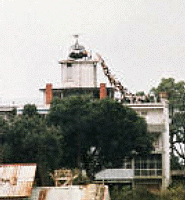 The picture of a Huey
helicopter evacuating people from the top of what was billed as
being the U.S. Embassy in Saigon during the last week of April
1975 during the fall of Saigon helped to establish this
myth.
The picture of a Huey
helicopter evacuating people from the top of what was billed as
being the U.S. Embassy in Saigon during the last week of April
1975 during the fall of Saigon helped to establish this
myth.
This famous picture is the property of Corbus-Bettman Archives. It was originally a UPI photograph that was taken by an Englishman, Mr. Hugh Van Ess.
Here are some facts to clear up that poor job of reporting by the news media.
Facts about the fall of Saigon
It was a "civilian" (Air America) Huey not Army
or Marines.
It was NOT the U.S. Embassy. The building is the Pittman
Apartments. The U.S. Embassy and its helipad were much larger.
The evacuees were Vietnamese not American military.
The person that can be seen aiding the refugees is Mr. O.B.
Harnage. He was a CIA case officer and now retired in
Arizona.
Another famous
picture:
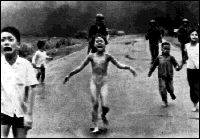
Myth: Kim Phuc, the little nine year old
Vietnamese girl running naked from the napalm strike near Trang
Bang on 8 June 1972, was burned by Americans bombing Trang
Bang.
No American had a direct involvement in this incident near Trang
Bang that burned Phan Thi Kim Phuc. The planes doing the bombing
near the village were VNAF (Vietnam Air Force) and were being
flown by Vietnamese pilots in support of South Vietnamese troops
on the ground. Even the AP photographer, Nick Ut, who took the
picture was Vietnamese. The incident in the photo took place on
the second day of a three day battle between the North Vietnamese
Army (NVA) who occupied the village of Trang Bang and the ARVN
(Army of the Republic of Vietnam) who were trying to force the NVA
out of the village. Recent reports in the news media that an
American commander ordered the air strike that burned Kim Phuc are
incorrect. The few Americans involved were in an advisory capacity
only. "We (Americans) had nothing to do with controlling VNAF,"
according to Lieutenant General (Ret) James F. Hollingsworth, the
Commanding General of TRAC. Also, it has been incorrectly reported
that two of Kim Phuc's brothers were killed in this incident. They
were Kim's cousins, not her brothers.
Facts about the end of the
war:
The fall of Saigon happened 30 April
1975, two years AFTER the American military left Vietnam. The last
American troops departed in their entirety 29 March 1973. How
could we lose a war we had already stopped fighting? We fought to
an agreed stalemate. The peace settlement was signed in Paris on
27 January 1973. It called for release of all U.S. prisoners,
withdrawal of U.S. forces, limitation of both sides' forces inside
South Vietnam and a commitment to peaceful reunification. [1996
Information Please Almanac]
The 140,000 evacuees in April 1975 during the fall of
Saigon consisted almost entirely of civilians and Vietnamese
military, NOT American military running for their lives. [1996
Information Please Almanac]
There were almost twice as many casualties in Southeast
Asia (primarily Cambodia) the first two years after the fall of
Saigon in 1975 then there were during the ten years the U.S. was
involved in Vietnam. [1996 Information Please Almanac]
THE UNITED STATES DID NOT LOSE THE WAR IN
VIETNAM!
POW-MIA Issue
(unaccounted-for versus missing in action)
Politics & People, On Vietnam, Clinton
Should Follow a Hero's Advice, Sen. John Kerrey is quoted as
saying about Vietnam, there has been "the most extensive
accounting in the history of human warfare" of those missing in
action. While there are still officially more than 2,200 cases,
there now are only 55 incidents of American servicemen who were
last seen alive but aren't accounted for. By contrast, there still
are 78,000 unaccounted-for Americans from World War II and 8,100
from the Korean conflict.
"The problem is that those who think the Vietnamese haven't
cooperated sufficiently think there is some central repository
with answers to all the lingering questions," notes Gen. John
Vessey, the former chairman of the Joint Chiefs of Staff and the
Reagan and Bush administration's designated representative in MIA
negotiations. "In all the years we've been working on this we have
found that's not the case." [The Wall Street Journal]
More realities about
war:
Post Traumatic Stress Disorder (PTSD) - it was not invented or unique to Vietnam Veterans. It was called "shell shock" and other names in previous wars. It also can be caused by an automobile accident or other traumatic event. It does not have to be war related. The Vietnam War helped medical progress in this area.
Agent Orange - other wars had similar problems. Atomic radiation in World War II and mustard gas in World War I. Even Desert Storm has a similar problem.
Atrocities - every war has atrocities. War is brutal and not fair. Innocent people get killed.
Restraining the military in Vietnam in hind sight probably prevented a nuclear war with China or Russia. The Vietnam War was shortly after China got involved in the Korean war, the time of the Cuban missile crisis, Soviet aggression in Eastern Europe and the proliferation of nuclear bombs. In all, a very scary time for our country.
SOURCES
[Nixon] No More Vietnams by Richard
Nixon
[Parade Magazine] August 18, 1996 page 10.
[CACF] (Combat Area Casualty File) November 1993. (The CACF is the basis for the Vietnam Veterans Memorial, i.e. The Wall), Center for Electronic Records, National Records Center
[All That We Can Be] All That We Can Be by Charles C. Moskos and John Sibley Butler
[Westmoreland] Speech by General William C. Westmoreland before the Third Annual Reunion of the Vietnam Helicopter Pilots Association (VHPA) at the Washington, DC Hilton Hotel on July 5th, 1986 (reproduced in a Vietnam Helicopter Pilots Association Historical Reference Directory Volume 2A)
[McCaffrey]Speech by Lt. Gen. Barry R. McCaffrey, (reproduced in the Pentagram, June 4, 1993) assistant to the Chairman of the Joint Chiefs of Staff, to Vietnam veterans and visitors gathered at "The Wall", Memorial Day 1993.
[Houk] Testamony by Dr. Houk, Oversight on Post-Traumatic Stress Disorder, 14 July 1988 page 17, Hearing before the Committee on Veterans' Affairs United States Senate one hundredth Congress second session. Also "Esitmating the Number of Suicides Among Vietnam Veterans" (Am J Psychiatry 147, 6 June 1990 pages 772-776)
[The Wall Street Journal] The Wall Street Journal, 1 June 1996 page A15.
[VHPA 1993] Vietnam Helicopter Pilots Association 1993 Membership Directory page 130.
[VHPA Databases] Vietnam Helicopter Pilots Association Databases.
[1996 Information Please Almanac] 1995 Information Please Almanac Atlas & Yearbook 49th edition, Houghton Mifflin Company, Boston & New York 1996, pages 117, 161 and 292.
77th Field Artillery Regiment Association Webmaster
Return to Main Page
Last Update - January 7, 2022